A project decades in the making…
Introduction
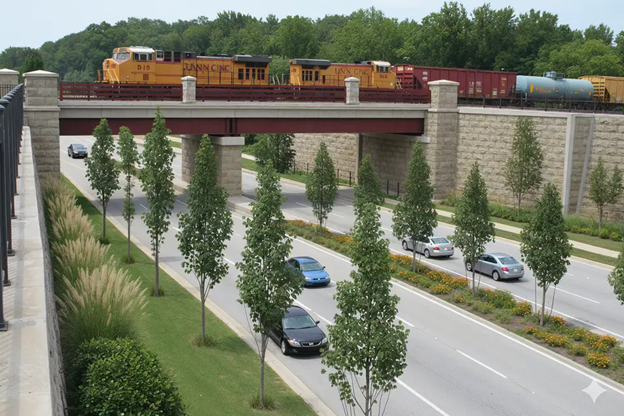
For the past twenty years, MUD 500, in conjunction with its developer, Caldwell Companies (“Caldwell”), the Texas Department of Transportation (“TxDOT”), and the Union Pacific Railroad (“UPRR”), has been working on an extension of Greenhouse Road north of Mound Road to connect to U.S. 290 and Skinner Road. This critical regional mobility project includes construction of a roadway underpass with a dedicated pedestrian trail, as generally depicted in the above rendering, a stormwater pump station to mitigate flooding risk on the new roadway, and replacement of a portion of the existing U.S. 290 bridge over Skinner Road.
Under an agreement between MUD 500 and TxDOT for the project, MUD 500 was responsible for completing the design, land acquisition, and utility relocations for the project, which were completed in late 2025, with TxDOT responsible for bid advertisement and construction oversight.
Design
Over the past five-plus years, MUD 500 worked closely with TxDOT, UPRR, and Harris County to complete the detailed design plans for the project. Due to an existing agreement between Harris County and UPRR, MUD 500’s potential design options were limited by UPRR to either a bridge over the existing UPRR double railroad tracks or an underpass beneath them. The existing site conditions, including the railroad, configuration of the U.S. 290 bridge and frontage roads, and existing development on the north side of U.S. 290, meant that an underpass was determined to be the only feasible option. TxDOT also determined that a portion of the existing U.S. 290 bridge at Skinner Road required replacement to provide deeper structural supports for the new roadway underpass.
Caldwell dedicated the land and easements necessary for construction of the project. MUD 500 also worked with TxDOT and Harris County for the use of a shared easement for Harris County’s construction of necessary drainage facilities for the extension of Mound Road east of Greenhouse Road, and the underpass pump station outfall, to ensure the most efficient use of available land. This design also provided for sufficient space to allow for construction of a planned Harris County Emergency Services District No. 9 (“ESD 9”) fire station near the intersection of Greenhouse Road and Mound Road, which is anticipated to significantly improve response times for emergency services in and around the Towne Lake community.
To help keep the project on schedule, MUD 500 also coordinated with numerous oil and gas, electricity, telecommunications, and other utility providers to complete the relocation of existing utilities that would have interfered with construction. These relocations are now complete, and the site is ready for construction.
Bidding and Construction
MUD 500 completed the final stages of design in late 2025, and on February 4, 2026, following public advertisement for bids, TxDOT opened the bids for the construction contract for the project. The lowest bid was submitted by Harper Brothers, with a $74 million base bid and approximately $2 million in force account items for work required to be completed by UPRR, which will be paid as invoiced and may not be fully utilized.
On February 28, 2026, TxDOT awarded the construction contract to Harper Brothers, and the pre-construction meeting currently is being scheduled for early May 2026. Following the pre-construction meeting, MUD 500 expects to receive more detailed schedule information from the contractor. Construction is anticipated to begin this summer and to continue through the late 2029 or early 2030. In consultation with MUD 500, TxDOT included early completion incentives and late completion penalties in the construction contract to encourage timely completion of the project.
Following construction, TxDOT will maintain state-owned facilities, UPRR will maintain the railroad bridge, and Harris County will maintain the new county roadway facilities.
Funding
MUD 500’s Board has believed from the beginning that this project is a regional mobility project that will benefit Towne Lake and many surrounding communities in northwest Harris County. To that end, MUD 500 worked with the Houston-Galveston Area Council to secure $60,800,000 in federal funds for the construction of the project.
MUD 500 also worked with local funding partners, including Harris County Precinct 3, the Harris County Toll Road Authority (“HCTRA”), and ESD 9, to help further reduce costs to MUD 500 residents. A summary of MUD 500’s funding partners and their respective contributions is provided in the chart below. The total estimated project cost, including design, utility relocations, and construction, is approximately $88.5 million. MUD 500 is grateful to all of its funding partners who have helped to make this critical mobility project happen.
MUD 500 committed to paying for 100% of the design and utility relocations for the project, which totaled approximately $12.5 million. Together with MUD 500’s share of the construction costs, MUD 500’s total expected contribution for the project is just under $19.5 million.
MUD 500’s Funding Partners
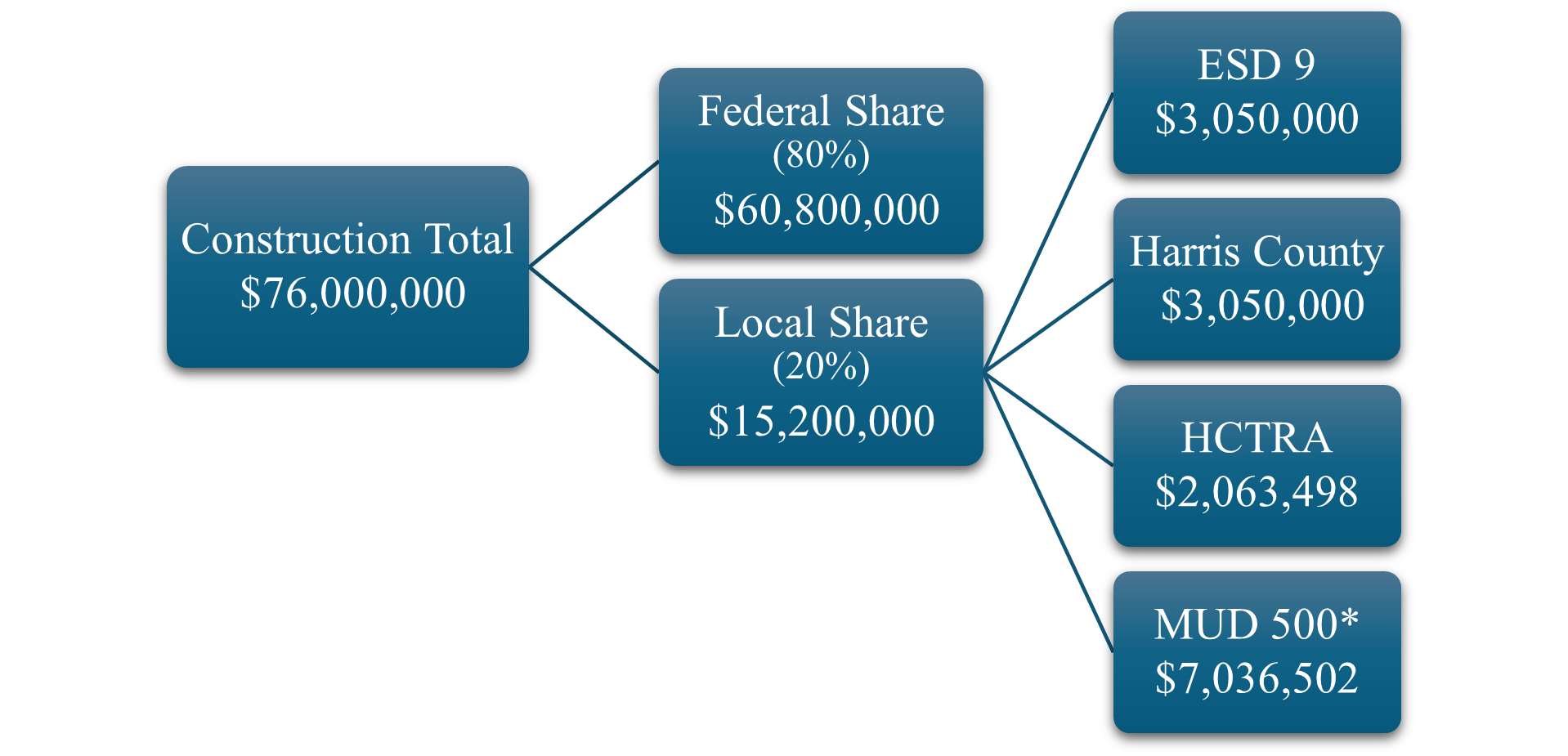
* MUD 500 is also responsible for 100% of the design and utility relocation costs associated with the project, and its total current and proposed contribution is approximately $19,457,000.
Next Steps
Now that design is complete, and TxDOT is overseeing the construction phase of the underpass project, MUD 500 anticipates that TxDOT will be in the best position to provide regular updates regarding the project. For any questions or for more information as construction progresses, please contact TxDOT’s Public Information Office, at hou-piowebmail@txdot.gov. To report any concerns or complaints, please utilize TxDOT’s online reporting form, available at https://www.txdot.gov/about/contact-us/report-an-issue.html.
We respectfully ask for the community’s patience and cooperation during construction, as temporary inconveniences will help deliver long-term transportation benefits for Towne Lake residents and the broader community.